These answers belong to our October 14, 2026 puzzle. They are not the official krillion.io daily solutions. Each prompt defines a bounded list; use the wording to check whether your candidate belongs before thinking about points.
The October 14, 2026 challenge brings together games, geology, sport, technology, geography and music. These notes follow the seven prompts in their playing order, using the answers and spellings published for this exact date. Compare the examples below after your round: the point differences describe this independent edition's scoring, not how frequently other players choose an answer. Each reference explains the subject; our editors assign the game points.
1 / Games
Name one of the six types of chess piece.
“Pawn” receives 30 points, while “Rook” receives 60; switching from the first to the second would add 30 points in this round. The category boundary still matters. Standard chess has six piece types. Each side starts with sixteen pieces because several types appear more than once; a piece’s colour does not make it a separate type. “Knight” is accepted for 60 points, and the recorded alias “horse” resolves to it with the same points; it is another way to name that answer, not an extra item in the list.
Standard question · difficulty is separate from answer points.
Name a geological period in the Phanerozoic eon, using the international twelve-period scheme.
Consider “Carboniferous” and “Jurassic” before reading the full list. The Phanerozoic contains the Paleozoic, Mesozoic and Cenozoic eras. This set treats Carboniferous as one period; Mississippian and Pennsylvanian are its international subperiods, not extra answers. “Carboniferous” receives 60 points, while “Jurassic” receives 10; switching from the first to the second would cost 50 points in this round. “Paleogene” is accepted for 100 points, and the recorded alias “Palaeogene” resolves to it with the same points; it is another way to name that answer, not an extra item in the list.
Specialist question · difficulty is separate from answer points.
Name a reference mineral on the original ten-step Mohs hardness scale.
Consider “Orthoclase” and “Calcite” before reading the full list. Mohs hardness compares which mineral can scratch another. It is an ordered comparison rather than a linear scale: a value of ten is not simply twice as hard as five. “Orthoclase” receives 100 points, while “Calcite” receives 60; switching from the first to the second would cost 40 points in this round. Another accepted response is “Corundum”, worth 100 points in this edition. The recorded alias “orthoclase feldspar” resolves to “Orthoclase” and receives the same 100 points; it is another accepted way to name that answer, not an extra item in the list.
Advanced question · difficulty is separate from answer points.
“Yellow” is a valid 60-point option for this prompt. The five rings are blue, yellow, black, green and red. White belongs to the flag’s background, and the IOC does not assign an individual ring colour to an individual continent. “Red” and “Blue” each receive 10 points, so switching between those two names does not improve this round's score. This prompt's published list contains 5 accepted names.
Standard question · difficulty is separate from answer points.
This prompt's published list contains 6 accepted names. Among them are “h6”, “h5” and “h2”. HTML heading elements run from h1 to h6 and express heading levels. The head element holds document metadata; it is not a visible numbered heading. “h6” receives 100 points, while “h5” receives 60; switching from the first to the second would cost 40 points in this round. For the third example, “h2”, the published tier is 30 points.
Advanced question · difficulty is separate from answer points.
Australia has six states. The Australian Capital Territory and Northern Territory are self-governing territories, so they are not answers to a question specifically about states. “New South Wales” receives 10 points, while “Queensland” receives 30; switching from the first to the second would add 20 points in this round. Another accepted response is “South Australia”, worth 60 points in this edition. The recorded alias “nsw” resolves to “New South Wales” and receives the same 10 points; it is another accepted way to name that answer, not an extra item in the list.
Standard question · difficulty is separate from answer points.
Name one of the four standard modern orchestral brass families.
“Horn” is accepted for 100 points, and the recorded alias “French horn” resolves to it with the same points; it is another way to name that answer, not an extra item in the list. To compare two other candidates, take “Trombone” and “Trumpet”. Trumpet, horn, trombone and tuba are the standard orchestral brass families. A saxophone is classified as woodwind because a reed produces its vibration, even though its body is usually metal. “Trombone” receives 30 points, while “Trumpet” receives 10; switching from the first to the second would cost 20 points in this round.
Advanced question · difficulty is separate from answer points.
Game point tiers, not measured player frequencies.
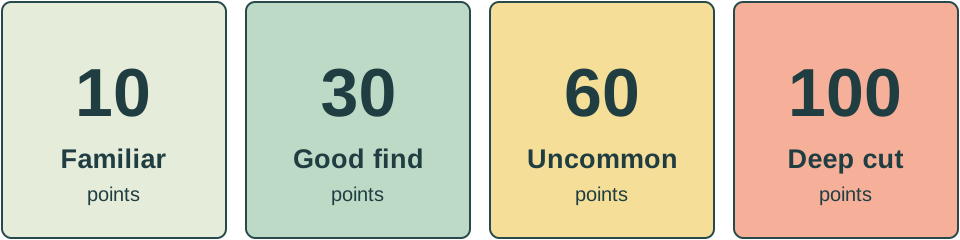
Every accepted answer receives 10, 30, 60 or 100 editorial points. A less familiar answer may receive a higher tier, but these values do not measure how frequently real players choose it. Each of the seven questions contributes at most 100 points, so the daily total is out of 700. Explicit aliases and unambiguous single-letter corrections in longer names are supported. The game displays a corrected name when it accepts a typo. Review after playing if you want to avoid spoilers.
Each prompt describes a set, such as planets or chess pieces. Every listed member is accepted. The points beside it are editorial game scores: a higher number rewards the answer we chose as less obvious, rather than measuring how many players picked it.
My answer wasn’t accepted
Check the exact scope: Canadian provinces exclude territories, for example. Spacing, capitalisation, accents and punctuation are ignored, and selected common aliases are accepted. We also accept an unambiguous one-letter typo or adjacent-letter swap in a name of at least six letters, unless that question disables typo matching. Short or ambiguous matches must be typed correctly. Feedback shows the corrected name and a knowledge note. If an answer is missing, use “This answer should count” in the game to open an email draft to [email protected] for review. The revealed list defines what this edition accepts.
Questions about this daily answer set
Are these the official Krillion answers for October 14, 2026?
No. This page covers Little Fun Games’s independent October 14, 2026 puzzle. Our seven questions, accepted answers and editorial points are separate from the original game at krillion.io.
Why does each question have several accepted answers?
Each question asks you to name one member of a defined set. Every name in its accepted list counts; you only submit one answer per question. Read the category boundary and compare the alternatives after playing.
What do the points beside each answer mean?
The 10, 30, 60 and 100 point tiers are editorial game choices. They do not measure how often real players submit each answer. Seven questions can earn at most 700 points, and the same accepted answer keeps its assigned score.