These answers belong to our October 7, 2026 puzzle. They are not the official krillion.io daily solutions. Each prompt defines a bounded list; use the wording to check whether your candidate belongs before thinking about points.
October 7 moves from a broad list of fifty US states to tightly defined lists of nerves, ancient monuments and sporting events. Several topics also appeared in the opening edition, but today’s review takes a different angle: exact naming, alternate spellings and ways to organise a list before choosing. Use the linked references for the subject matter and the revealed lists for this edition’s accepted answers.
1 / Geography
Name one of the 50 US states.
Washington illustrates why a place name alone can be misleading. Washington state belongs in this list; Washington, DC does not, because the prompt asks for a state rather than the federal district. Cities and territories are excluded for the same reason. To explore beyond California and Texas, try recalling pairs such as “North Dakota” and “South Dakota”, or “Virginia” and “West Virginia”. Each full name identifies its own accepted state.
Name one of the first 20 chemical elements by atomic number.
This round gives you a chance to check spelling as well as recall. “Aluminium” and its recorded alias “aluminum” lead to the same accepted element; “Sulfur” and “sulphur” likewise share one answer entry. An alternative spelling does not earn a second set of points or widen the list beyond twenty elements. If you are unsure whether a candidate belongs, return to the hydrogen-to-calcium boundary rather than guessing from how common the material is.
Short names can be complete answers. “Mu”, “Nu” and “Xi” all belong to the Greek alphabet, even though each contains only two English letters. The task is not to write a Greek word or explain what a letter represents in an equation. Longer options such as “Epsilon”, “Omicron” and “Lambda” are available too. Reviewing these alongside the short names is a useful way to expand your recall beyond the alphabet’s opening letters.
The twelve cranial nerves have names as well as the conventional Roman numerals I through XII. This prompt requests the names, so a numeral alone is not enough. “Optic” and the recorded alias “optic nerve” both identify the same accepted entry. Longer alternatives include “Glossopharyngeal” and “Vestibulocochlear”. Review the complete spelling before another attempt; remembering that a nerve exists is helpful, but the answer field still needs to identify which one you mean.
Hurdle distance is the detail that can turn an otherwise plausible answer into the wrong event. This women’s outdoor heptathlon uses 100 metres hurdles, while its closing race is 800 metres. The list accepts “100m hurdles” as an abbreviation of the full hurdle-event name. If distances are difficult to recall, one of the field events—such as “Shot put” or “Javelin throw”—offers another way into the same seven-event set.
Name one of the Seven Wonders of the Ancient World.
Ancient is doing real work in this prompt. The accepted set concerns the traditional Mediterranean and Near Eastern wonders, not a modern travel poll. Only the Great Pyramid survives largely intact, while the existence and location of the Hanging Gardens remain debated; both nevertheless belong to the traditional list used by the game. Longer names can be shortened where an alias is recorded: “statue of zeus” identifies “Statue of Zeus at Olympia”.
Name one of the twelve sovereign countries in South America.
Try separating two questions in your mind: is this a place in South America, and is it a sovereign country? Both conditions must hold. The game’s twelve-country list accepts “Chile”, “Peru”, “Colombia” and “Venezuela”, as well as choices such as “Ecuador” and “Uruguay”. A capital city is not a substitute for its country. A useful exercise after this round is to reconstruct several different country names before looking at their point tiers.
Game point tiers, not measured player frequencies.
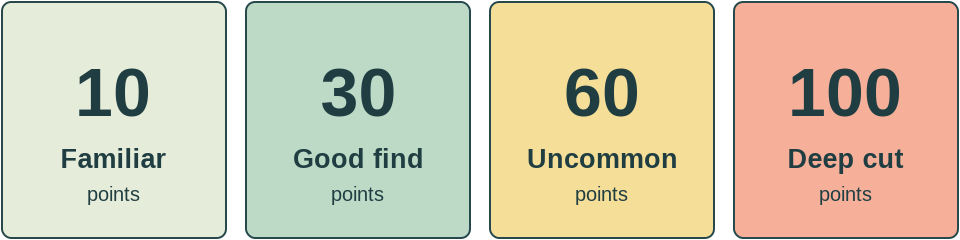
Every accepted answer receives 10, 30, 60 or 100 editorial points. A less familiar answer may receive a higher tier, but these values do not measure how frequently real players choose it. Each of the seven questions contributes at most 100 points, so the daily total is out of 700. Explicit aliases and unambiguous single-letter corrections in longer names are supported. The game displays a corrected name when it accepts a typo. Review after playing if you want to avoid spoilers.
Each prompt describes a set, such as planets or chess pieces. Every listed member is accepted. The points beside it are editorial game scores: a higher number rewards the answer we chose as less obvious, rather than measuring how many players picked it.
My answer wasn’t accepted
Check the exact scope: Canadian provinces exclude territories, for example. Spacing, capitalisation, accents and punctuation are ignored, and selected common aliases are accepted. We also accept an unambiguous one-letter typo or adjacent-letter swap in a name of at least six letters, unless that question disables typo matching. Short or ambiguous matches must be typed correctly. Feedback shows the corrected name and a knowledge note. If an answer is missing, use “This answer should count” in the game to open an email draft to [email protected] for review. The revealed list defines what this edition accepts.
Questions about this daily answer set
Are these the official Krillion answers for October 7, 2026?
No. This page covers Little Fun Games’s independent October 7, 2026 puzzle. Our seven questions, accepted answers and editorial points are separate from the original game at krillion.io.
Why does each question have several accepted answers?
Each question asks you to name one member of a defined set. Every name in its accepted list counts; you only submit one answer per question. Read the category boundary and compare the alternatives after playing.
What do the points beside each answer mean?
The 10, 30, 60 and 100 point tiers are editorial game choices. They do not measure how often real players submit each answer. Seven questions can earn at most 700 points, and the same accepted answer keeps its assigned score.