These answers belong to our October 8, 2026 puzzle. They are not the official krillion.io daily solutions. Each prompt defines a bounded list; use the wording to check whether your candidate belongs before thinking about points.
The October 8 questions repeatedly distinguish a familiar name from the exact category requested. A Swiss town is not automatically a canton, a dwarf planet is not one of the eight planets, and a Canadian territory is not a province. The notes below explain those boundaries and give concrete alternatives. Keep the published answer list in view when reviewing; this archive preserves the spellings and scores of the original daily set.
1 / Geography
Name one of Switzerland’s 26 cantons.
Some Swiss place names need a qualifier before they identify one canton. “Basel-Stadt” and “Basel-Landschaft” are separate entries, as are “Appenzell Ausserrhoden” and “Appenzell Innerrhoden”. Simply writing Basel or Appenzell leaves that distinction unresolved. Language variants can still be valid when recorded: “grisons” identifies “Graubünden” in this edition. The lesson is to preserve the administrative distinction while recognising that one canton can have more than one accepted name.
Name a chemical element in group 18: the noble gases.
Look at group 18 rather than making a list of substances that happen to be gases. Helium, neon and argon are familiar members, but the published set also includes “Krypton”, “Xenon”, “Radon” and the synthetic element “Oganesson”. That last inclusion is a useful reminder that this question is defined by position in the periodic table. A less familiar element name is not a guess outside the category when it occupies the specified group.
Name one of the eight planets in our Solar System.
Pluto is a tempting response because it belongs to the separate dwarf-planet category, but this prompt explicitly asks for one of the eight planets. The Sun and the Moon are outside the set too. The accepted choices include “Mercury” and “Venus” as well as “Uranus” and “Neptune”. All four satisfy the same membership rule; a higher game score does not make one more of a planet than another.
Name one of the seven traditional rainbow colours.
The seven-colour convention is a naming system for a continuous spectrum, not seven physically separate stripes with sharp scientific boundaries. That is why “Indigo” counts here while a more specific shade such as turquoise does not. “Orange” and “Violet” are useful alternatives if red or blue comes to mind first. Keep the wording traditional rainbow colours in view: inventing a more precise colour description will not expand this particular accepted set.
These are the twelve traditional Western astrological sign names. They are a cultural naming system, rather than a scientific method for predicting events, and astronomical constellations use different boundaries. The answer list contains “Capricorn”, “Aquarius” and “Sagittarius”, for example. Submit the sign name itself rather than a description of its animal or symbol. A list of Chinese zodiac animals would answer a different question, even where the subjects seem related.
Name one of the 20 standard protein-building amino acids.
The word standard restricts this question to a conventional set of twenty amino acids. Selenocysteine and pyrrolysine matter biologically, but they fall outside the specified list. The game asks for full names rather than one-letter or three-letter codes. Its recorded aliases include “glutamate” for “Glutamic acid” and “aspartate” for “Aspartic acid”. These are accepted naming choices within existing entries, not additional answers that increase the set beyond twenty.
Canada’s ten provinces and three territories should not be merged for this round. Yukon, Nunavut and the Northwest Territories are part of Canada, but none is a province. Among the accepted alternatives are “Manitoba”, “Saskatchewan” and “Nova Scotia”. The longer provincial name “Newfoundland and Labrador” is also present, with “newfoundland” recorded as an alias. You are identifying a province, so there is no need to supply its capital or abbreviate it unless that spelling is explicitly supported.
Game point tiers, not measured player frequencies.
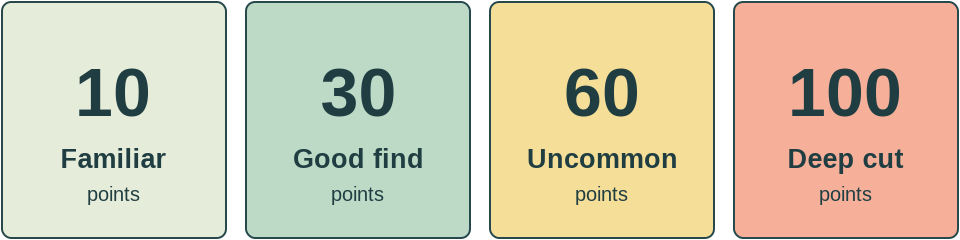
Every accepted answer receives 10, 30, 60 or 100 editorial points. A less familiar answer may receive a higher tier, but these values do not measure how frequently real players choose it. Each of the seven questions contributes at most 100 points, so the daily total is out of 700. Explicit aliases and unambiguous single-letter corrections in longer names are supported. The game displays a corrected name when it accepts a typo. Review after playing if you want to avoid spoilers.
Each prompt describes a set, such as planets or chess pieces. Every listed member is accepted. The points beside it are editorial game scores: a higher number rewards the answer we chose as less obvious, rather than measuring how many players picked it.
My answer wasn’t accepted
Check the exact scope: Canadian provinces exclude territories, for example. Spacing, capitalisation, accents and punctuation are ignored, and selected common aliases are accepted. We also accept an unambiguous one-letter typo or adjacent-letter swap in a name of at least six letters, unless that question disables typo matching. Short or ambiguous matches must be typed correctly. Feedback shows the corrected name and a knowledge note. If an answer is missing, use “This answer should count” in the game to open an email draft to [email protected] for review. The revealed list defines what this edition accepts.
Questions about this daily answer set
Are these the official Krillion answers for October 8, 2026?
No. This page covers Little Fun Games’s independent October 8, 2026 puzzle. Our seven questions, accepted answers and editorial points are separate from the original game at krillion.io.
Why does each question have several accepted answers?
Each question asks you to name one member of a defined set. Every name in its accepted list counts; you only submit one answer per question. Read the category boundary and compare the alternatives after playing.
What do the points beside each answer mean?
The 10, 30, 60 and 100 point tiers are editorial game choices. They do not measure how often real players submit each answer. Seven questions can earn at most 700 points, and the same accepted answer keeps its assigned score.