These answers belong to our October 9, 2026 puzzle. They are not the official krillion.io daily solutions. Each prompt defines a bounded list; use the wording to check whether your candidate belongs before thinking about points.
The October 9 set combines books, awards and mythology with short naming puzzles in music, nature and geography. Several answers have two valid names, but an alias does not create a new member of the category. Today’s explanations focus on those distinctions: completed novels, original versus associated prize fields, biological stages, and the geographic models named in each prompt. These are the independent edition’s answers, not official Krillion solutions.
1 / Books
Name one of Jane Austen’s six completed major novels.
Completed major novels is a narrower category than everything Jane Austen wrote. The six novels in this set appeared between 1811 and 1818; Northanger Abbey and Persuasion were published after her death. An unfinished work such as Sanditon therefore does not qualify. If “Pride and Prejudice” is your immediate answer, “Mansfield Park” or “Northanger Abbey” gives you another valid title to remember. A character’s name alone is not a substitute for a book title.
Advanced question · difficulty is separate from answer points.
Name a category in the Nobel Prizes or the associated prize in economic sciences.
The wording deliberately includes the associated prize in economic sciences. Alfred Nobel’s will established five prize fields, while the economic sciences prize was added later in his memory. Thus “Economic Sciences” is accepted without pretending it was an original category. “Medicine” is also a supported shorthand for “Physiology or Medicine”. Mathematics is outside this six-field list, and naming an individual laureate would not answer the request for a prize category.
Advanced question · difficulty is separate from answer points.
Hesiod names nine Muses in the Theogony. Later traditions connect them with different arts, but this round asks who they are, not which discipline each represents. “Euterpe”, “Polyhymnia” and “Terpsichore” are three valid alternatives to “Calliope”. Transliteration can change a familiar spelling: the recorded alias “Ourania” identifies “Urania”. Use a figure’s name rather than an art such as music or poetry, and consult the primary text if you want to explore the names beyond the game.
Specialist question · difficulty is separate from answer points.
Name a musical note letter in the standard English A–G system.
The English note-letter system runs from A through G and repeats in each octave. A sharp or flat changes a pitch without introducing a new letter into that sequence. For this deliberately small naming task, “B”, “E” or “F” is already a complete response; adding a sharp sign or naming a key would answer more than the prompt asks. The seven letters remain valid regardless of their different editorial point tiers in this game.
Standard question · difficulty is separate from answer points.
Name a stage in a butterfly’s four-stage life cycle.
A caterpillar and a larva are two names for the same stage here. Similarly, chrysalis refers to the butterfly pupa rather than a fifth stage. The four-stage sequence is egg, larva, pupa and adult. The answer list records “chrysalis” under “Pupa” and “imago” under “Adult”, making either spelling usable. Naming a butterfly species would miss the question: the challenge is to identify a stage of complete metamorphosis, not a particular kind of butterfly.
Advanced question · difficulty is separate from answer points.
The five named oceans are regions of one interconnected ocean. This prompt includes the Southern Ocean surrounding Antarctica, and the alias “Antarctic Ocean” identifies that same accepted entry. A sea such as the Mediterranean is not one of the five requested names. “Pacific”, “Atlantic”, “Indian” and “Arctic” complete the list. You can include the word Ocean through the recorded aliases, but the shorter canonical names are enough to answer the question.
Standard question · difficulty is separate from answer points.
A continent list depends on the model being used. This prompt chooses seven, separating Europe from Asia and North America from South America. A response that combines either pair would therefore miss its stated boundary. The game uses “Australia” for one slot and accepts “Oceania” as the common regional label for it; that does not create an eighth continent. “Antarctica” is also a valid choice, distinct from the Southern Ocean discussed in the preceding question.
Standard question · difficulty is separate from answer points.
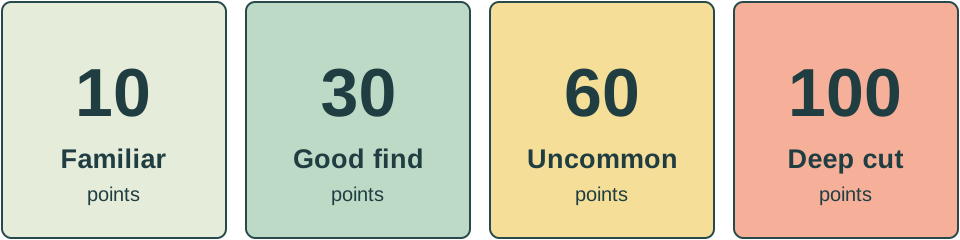
Game point tiers, not measured player frequencies.
Every accepted answer receives 10, 30, 60 or 100 editorial points. A less familiar answer may receive a higher tier, but these values do not measure how frequently real players choose it. Each of the seven questions contributes at most 100 points, so the daily total is out of 700. Explicit aliases and unambiguous single-letter corrections in longer names are supported. The game displays a corrected name when it accepts a typo. Review after playing if you want to avoid spoilers.
Each prompt describes a set, such as planets or chess pieces. Every listed member is accepted. The points beside it are editorial game scores: a higher number rewards the answer we chose as less obvious, rather than measuring how many players picked it.
My answer wasn’t accepted
Check the exact scope: Canadian provinces exclude territories, for example. Spacing, capitalization, accents and punctuation are ignored, and selected common aliases are accepted. We also accept an unambiguous one-letter typo or adjacent-letter swap in a name of at least six letters, unless that question disables typo matching. Short or ambiguous matches must be typed correctly. Feedback shows the corrected name and a knowledge note. If an answer is missing, use “This answer should count” in the game to open an email draft to [email protected] for review. The revealed list defines what this edition accepts.