These answers belong to our October 18, 2026 puzzle. They are not the official krillion.io daily solutions. Each prompt defines a bounded list; use the wording to check whether your candidate belongs before thinking about points.
The October 18, 2026 challenge brings together geography, space, history, science and sport. These notes follow the seven prompts in their playing order, using the answers and spellings published for this exact date. Compare the examples below after your round: the point differences describe this independent edition's scoring, not how frequently other players choose an answer. Each reference explains the subject; our editors assign the game points.
1 / Geography
Name one of the twelve sovereign countries in South America.
Consider “Brazil” and “Chile” before reading the full list. The set contains the twelve sovereign countries geographically in South America. French Guiana is part of France, so it is not counted as an additional sovereign country. “Brazil” receives 10 points, while “Chile” receives 30; switching from the first to the second would add 20 points in this round. Another accepted response is “Argentina”, worth 10 points in this edition. This prompt's published list contains 12 accepted names.
Standard question · difficulty is separate from answer points.
Name one of the eight planets in our Solar System.
This prompt's published list contains 8 accepted names. Among them are “Jupiter”, “Earth” and “Mercury”. The eight planets orbit the Sun and have cleared their orbital neighbourhoods. Pluto belongs to the separate dwarf-planet category; the Sun and the Moon are not planets. “Jupiter” receives 30 points, while “Earth” receives 10; switching from the first to the second would cost 20 points in this round. For the third example, “Mercury”, the published tier is 60 points.
Standard question · difficulty is separate from answer points.
Name one of the Seven Wonders of the Ancient World.
“Great Pyramid of Giza” is a valid 10-point option for this prompt. The traditional ancient list centres on the Mediterranean and Near East. Only the Great Pyramid survives largely intact; the existence and location of the Hanging Gardens remain debated. “Temple of Artemis” receives 60 points, while “Statue of Zeus at Olympia” receives 100; switching from the first to the second would add 40 points in this round. The recorded alias “pyramids of giza” resolves to “Great Pyramid of Giza” and receives the same 10 points; it is another accepted way to name that answer, not an extra item in the list.
Advanced question · difficulty is separate from answer points.
Name a chemical element in group 18: the noble gases.
“Oganesson” is accepted for 100 points, and the recorded alias “Oganeson” resolves to it with the same points; it is another way to name that answer, not an extra item in the list. To compare two other candidates, take “Neon” and “Radon”. Group 18 is the rightmost group of the periodic table. This set includes the synthetic element oganesson as well as the better-known helium, neon and argon. “Neon” receives 10 points, while “Radon” receives 100; switching from the first to the second would add 90 points in this round.
Advanced question · difficulty is separate from answer points.
Switzerland has twenty-six cantons. Basel-Stadt and Basel-Landschaft are separate answers, as are the two Appenzells; simply writing Basel or Appenzell does not identify one canton. “Bern” receives 10 points, while “Basel-Stadt” receives 60; switching from the first to the second would add 50 points in this round. Another accepted response is “Ticino”, worth 30 points in this edition. The recorded alias “basel city” resolves to “Basel-Stadt” and receives the same 60 points; it is another accepted way to name that answer, not an extra item in the list.
Specialist question · difficulty is separate from answer points.
The recorded alias “100 hurdles” resolves to “100 metres hurdles” and receives the same 100 points; it is another accepted way to name that answer, not an extra item in the list. To compare two other candidates, take “High jump” and “100 metres hurdles”. The women’s outdoor heptathlon has seven events over two days. Its sprint hurdles cover 100 metres, and its last event is the 800 metres. Indoor heptathlon uses a different set. “High jump” receives 10 points, while “100 metres hurdles” receives 100; switching from the first to the second would add 90 points in this round. Another accepted response is “800 metres”, worth 60 points in this edition.
Advanced question · difficulty is separate from answer points.
Name one of the first 20 chemical elements by atomic number.
Atomic number counts the protons in an atom’s nucleus. This set stops at calcium, number 20, so familiar elements such as iron and gold fall outside the question. “Nitrogen” and “Sodium” each receive 30 points, so switching between those two names does not improve this round's score. Another accepted response is “Hydrogen”, worth 10 points in this edition. The recorded alias “Phosporus” resolves to “Phosphorus” and receives the same 100 points; it is another accepted way to name that answer, not an extra item in the list.
Standard question · difficulty is separate from answer points.
Game point tiers, not measured player frequencies.
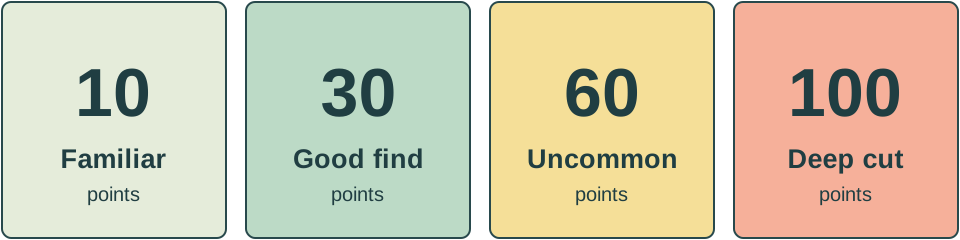
Every accepted answer receives 10, 30, 60 or 100 editorial points. A less familiar answer may receive a higher tier, but these values do not measure how frequently real players choose it. Each of the seven questions contributes at most 100 points, so the daily total is out of 700. Explicit aliases and unambiguous single-letter corrections in longer names are supported. The game displays a corrected name when it accepts a typo. Review after playing if you want to avoid spoilers.
Each prompt describes a set, such as planets or chess pieces. Every listed member is accepted. The points beside it are editorial game scores: a higher number rewards the answer we chose as less obvious, rather than measuring how many players picked it.
My answer wasn’t accepted
Check the exact scope: Canadian provinces exclude territories, for example. Spacing, capitalisation, accents and punctuation are ignored, and selected common aliases are accepted. We also accept an unambiguous one-letter typo or adjacent-letter swap in a name of at least six letters, unless that question disables typo matching. Short or ambiguous matches must be typed correctly. Feedback shows the corrected name and a knowledge note. If an answer is missing, use “This answer should count” in the game to open an email draft to [email protected] for review. The revealed list defines what this edition accepts.
Questions about this daily answer set
Are these the official Krillion answers for October 18, 2026?
No. This page covers Little Fun Games’s independent October 18, 2026 puzzle. Our seven questions, accepted answers and editorial points are separate from the original game at krillion.io.
Why does each question have several accepted answers?
Each question asks you to name one member of a defined set. Every name in its accepted list counts; you only submit one answer per question. Read the category boundary and compare the alternatives after playing.
What do the points beside each answer mean?
The 10, 30, 60 and 100 point tiers are editorial game choices. They do not measure how often real players submit each answer. Seven questions can earn at most 700 points, and the same accepted answer keeps its assigned score.