STRATEGO / START HERE
Stratego Online: Rules, Pieces and Browser Play
Looking for Stratego online? Start with the 40-piece game: arrange a hidden army, learn what the opposing pieces can do, and find the flag. This is a guide, not a playable game window.
Unofficial Stratego guides written by Little Fun Games. No playable game is hosted on these pages. Not affiliated with, sponsored by, or endorsed by Jumbo or Hasbro. Stratego is a trademark of Jumbo.
What this browser version is
This Little Fun Games page is an independent reading guide. There is no Stratego engine, computer opponent or online matchmaking on this site at present. You can use the explanations on a phone or desktop while learning with a physical set, or keep them beside an external digital game. The illustrations are our own diagrams, not screenshots of an official product.
For an online destination, the publisher’s Stratego Original product page links to play.stratego.com. Follow that publisher-linked destination if you want to investigate the official service; its account requirements, supported devices and availability belong to its operator. We verified the publisher’s link on November 15, 2026, but did not complete a game there. A working link is not a promise that every device or region can play.
How a game works in 60 seconds
Think of the opening as a question: which route might lead to the enemy flag, and what can you afford to reveal to find out? Both players know the possible inventory, but neither knows the other player’s arrangement. A confrontation supplies evidence. A long Scout move supplies evidence too, even before a fight. Remembering those clues matters as much as keeping a powerful piece alive.
Your first game does not need an elaborate formation. Agree on the edition, count the pieces, place the armies behind a screen and learn one turn together. Once play begins, avoid looking at the opponent’s ranks between attacks. The hidden information is part of the game, not a detail to skip while learning.
Board and setup
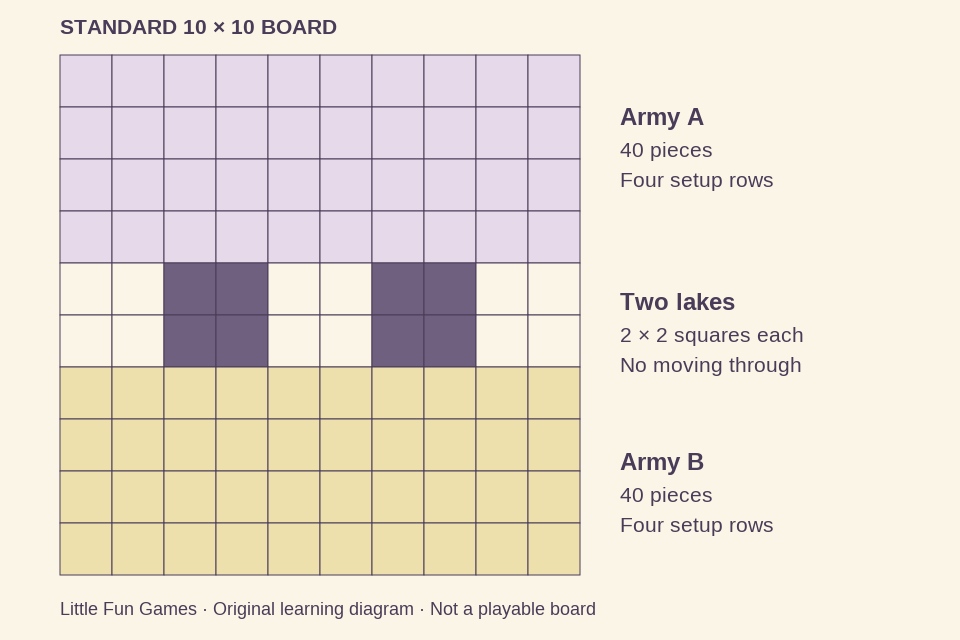
The standard board is a 10×10 grid with two central lakes, each covering a 2×2 block. That leaves 92 playable squares. Each army fills the four rows nearest its player: ten columns times four rows, or 40 starting spaces. The middle two rows start empty. Lakes are obstacles, not places where pieces can wait or take a shortcut.
A useful way to review a setup is to trace routes from your back rows toward the center. Which pieces can leave without first moving three others? Could an immovable Bomb block the only useful exit? Look at access as well as protection. A defended flag is valuable, but the rest of the army still needs room to investigate and attack.
How to win
Capturing the opposing Flag ends the game. You also win if your opponent cannot make a legal move or attack. Removing a Marshal does not itself end the game, and losing more pieces does not automatically mean you have lost. A small surviving force may still reach an exposed flag.
When considering a trade, ask what the position will look like afterward. Removing a defender might open a route, but sacrificing your last Miner could leave a suspected flag enclosure inaccessible. The practical value of a piece depends on the remaining obstacles and threats, not only on its printed rank.
How a turn works
Choose one movable piece. Normally it travels one square horizontally or vertically; a Scout has longer straight-line movement through empty squares. Entering an enemy-occupied square is an attack, resolved by comparing the pieces and applying any special rule. You do not make a normal move and then take a second unrelated action.
Before acting, check the route, the target and the consequence. An unknown target could be a Bomb. A known low-ranked piece could be bait for a stronger piece behind it. You are allowed to decline an attack, so a nearby enemy does not force an immediate gamble. Our rules page explains the exceptional matchups and the limits on repeated chasing.
Rules at a glance
Use this short reference during the first few turns, then follow the detailed guide for exceptions. The numbers here use Marshal 10 as the strongest ordinary rank. If your set uses a different numbering system, identify the pieces by name before comparing them.
| Part of play | Quick reference |
|---|---|
| Pieces | 40 per army: 33 movable pieces, six Bombs and a Flag. |
| Movement | Straight, never diagonal; most move one square, Scouts can travel farther. |
| Attack | Higher rank wins; equal ranks are removed; Miner and Spy have exceptions. |
| Victory | Capture the Flag, or leave the opponent with no legal move. |
Explore the guides
Choose the rules page when you need to settle a move or combat question. Use the pieces page to check an army’s inventory, distinguish stationary pieces from movable ones, and understand the smaller Barrage format. The strategy page is about choices rather than extra rules: how to gain information, preserve useful pieces and judge a flag attack.
The FAQ covers practical questions about players, age, device use and different editions. You can reach every guide from the navigation above and below. Nothing here requires a login, and reading a guide does not start an external game or download a game client.
- Stratego rules: setup, movement and resolving a fight.
- Stratego game pieces: all ranks, counts and the Barrage lineup.
- Stratego strategy: probing, protecting Miners and choosing attacks.
- Stratego FAQ: players, editions, age and online options.
References and edition notes
Rules checked November 15, 2026 against the 40-piece Original booklet. This guide uses Marshal 10 and Spy 1; check your own edition before applying a variant.
- Jumbo / PlayMonster: Stratego Original rules (PDF) — setup, movement, combat and repetition.
- Jumbo: Stratego Original product page — two players, age 8+, approximately 45 minutes, and the publisher’s online destination.
The publisher links to play.stratego.com ↗. It opens an external service; its account, device and availability requirements apply. A full online match has not been tested here.
Before you play
Can I play Stratego on this page?
Not yet. This page contains our rules and learning guides, with a clearly identified publisher-linked external destination. Little Fun Games does not currently provide a playable Stratego implementation or an embedded game.
Which rules does this guide use?
The standard 40-piece Original format, with Marshal 10 down to Spy 1. Check the booklet for your own edition before applying these explanations to a reduced-piece set or a variant.
Are there four lakes on the board?
No. The standard board has two lakes, each covering four squares. The lakes occupy eight squares altogether; pieces cannot enter or cross them.
Is capturing the Marshal enough to win?
No. Capturing the Flag wins, as does leaving the other player without a legal move or attack. A Marshal is a strong piece, not the game’s victory target.
Do I need an account to read these guides?
No. All five guides are readable without an account. Any external online game has its own sign-in requirements and policies.
Guide by Little Fun Games · Published and checked November 15, 2026 (UTC). Rules describe the named edition; strategy suggestions are editorial, not a tested winning formula.